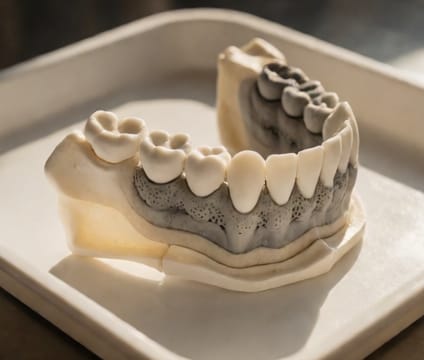
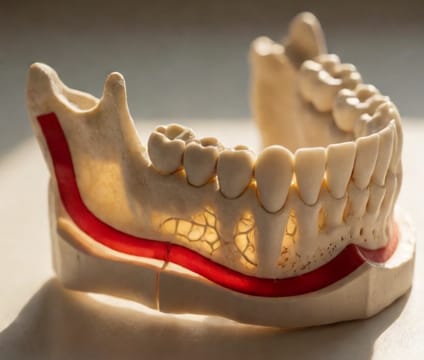
Tap to See: Osteotomy Depth & Angulation
Proper drilling angle and depth prevent sinus wall perforation and ensure implant placement safety in the upper back jaw.
In upper molars, the maxillary sinus sits just above the tooth roots. If the osteotomy hole angles too far toward the sinus floor or penetrates too deeply, the thin bone layer can tear—leading to a communic tract between mouth and sinus. This complication can cause infection, implant failure, or require a separate sinus repair procedure. Our model highlights safe depth markers and ideal angulation guidelines derived from typical anatomical landmarks like the sinus floor and root apices.
The drilling sequence starts with a small pilot hole, then gradually widens. Each drill size must stay aligned with the planned implant axis, which is determined by the remaining bone height, sinus position, and adjacent tooth roots. Our interactive step lets you pause at each drill size to inspect how depth and angle shift relative to the sinus membrane. Over-angulation by even 5 degrees in a shallow ridge can breach the sinus floor.
Preoperative CBCT scanning reveals exact sinus dimensions and root proximity, allowing clinicians to plan the most conservative osteotomy path. During placement, implant positioning tools often use the adjacent tooth roots or sinus floor as visual or tactile references. The model simulates how slight angulation errors shift the drill tip toward the sinus—reinforcing why a 3D-aware approach is safer than 2D estimation alone.