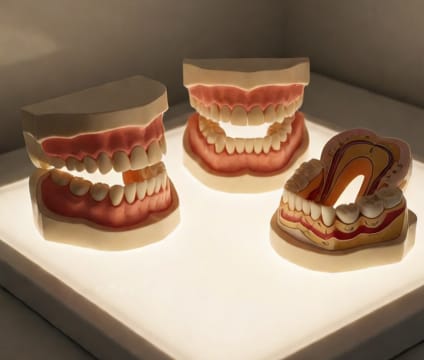
Implant Types by Anatomy
Endosseous implants anchor directly into jawbone, while subperiosteal and zygomatic options serve patients with limited bone volume.
Endosseous implants—screw- or cylinder-shaped titanium posts—are placed directly into the jawbone and form the foundation of most implant treatments. After placement, bone gradually grows around them in a process called osseointegration, securing the implant permanently. This type works well for patients with adequate bone height and width, and it supports single teeth, bridges, or full-arch restoration.
Subperiosteal implants sit on top of the jawbone but beneath the gum tissue. They’re custom-made from metal frames or screws that rest on the bone and protrude through the gum to hold prosthetic teeth. These are typically considered when bone loss is significant and the patient prefers to avoid bone grafting or cannot undergo prolonged healing phases due to health reasons.
Zygomatic implants are longer and anchored into the cheekbone rather than the upper jawbone, bypassing the need for sinus lifts or grafts. They’re used almost exclusively for severely atrophic upper jaws where traditional implants aren’t viable. Because of their complex placement, they require specialists trained in advanced craniofacial surgery techniques and careful planning using 3D imaging.